Live Feed
New
Today, June 28, 2026
23:14
The European Banking Authority (EBA) has unveiled a draft framework for sanctions that could impose fines of up to 12.5% of annual revenue on non-compliant cryptocurrency issuers, Cointelegraph reported. Under the proposal, issuers of significant Asset-Referenced Tokens (ARTs) could face penalties of up to 12.5% of their annual revenue, while issuers of significant E-Money Tokens (EMTs) could be fined up to 10%. The move is interpreted as a signal that the EU is strengthening its supervisory and enforcement stance as it fully implements the Markets in Crypto-Assets (MiCA) regulation. Cointelegraph noted that by establishing clear criteria for fines, authorities are signaling to the market that the era of regulatory grace periods is officially over. The industry has a public consultation period of approximately three months to submit feedback on the proposed framework, which ends on Sept. 28. Meanwhile, the temporary grace period for operations under MiCA is set to expire on July 1.
23:01
Ripple's recent preliminary approval for a MiCA-compliant Crypto Asset Service Provider (CASP) license from Luxembourg's financial regulator (CSSF) is not yet final, CryptoSlate reported. To secure final approval, Ripple must demonstrate that its Luxembourg branch is equipped with the necessary staff, capital, and control systems, and that it operates separately from its stablecoin, RLUSD. The media outlet noted that the preliminary approval was issued as a "green light letter," which functions as a conditional promise. This indicates that while there are no issues in principle, the process of verifying the remaining conditions has now begun. Ripple must now prove to the regulator, on a service-by-service basis, that its local entity can effectively operate its payment, custody, transfer, and stablecoin businesses.
23:01
Binance's Philippine partner, BlockShoals, has received in-principle approval for its StratBox regulatory sandbox from the Fintech Innovation Office of the country's Securities and Exchange Commission (SEC), founder Changpeng Zhao (CZ) announced on X.
The Philippine central bank (BSP) had previously stated that neither Binance nor BlockShoals holds a Virtual Asset Service Provider (VASP) license from the bank, adding that participation in the SEC's sandbox does not exempt a firm from the separate approvals needed to operate trading infrastructure.
22:53
According to CoinNess market monitoring, BTC has fallen below $59,000. BTC is trading at $58,970.2 on the Binance USDT market.
22:47
Julio Moreno, Head of Research at CryptoQuant, warned that if Strategy, the largest corporate holder of Bitcoin, were to sell its common stock (MSTR) or its BTC holdings to defend the price of its preferred stock (STRC), it would signal a key price level to the market. He cautioned that this would effectively tell speculators the BTC price level Strategy is trying to protect, prompting them to intensively attack that level. Moreno had previously pointed out that the primary reason STRC's price fell below $100 was the deterioration of Strategy's fundamentals. He suggested that the company's strategic priority should be to halt further Bitcoin purchases and focus on rebuilding its cash reserves.
22:40
The Bank for International Settlements (BIS) has warned that the accelerating expansion of the stablecoin market, currently estimated at around $316 billion, could fragment the global monetary system and weaken the control of national monetary authorities, Cointelegraph reported.
The BIS pointed out that stablecoins lack the institutional framework to support the safety and reliability required for them to become a large-scale payment method. It also highlighted the potential for poor management of reserve assets and a reduction in banks' capacity to lend to the real economy if deposits shift to stablecoins.
The report specifically noted that the spread of U.S. dollar stablecoins in countries with weaker currencies could undermine monetary sovereignty and the effectiveness of monetary policy, increasing the risk of volatile cross-border capital flows for emerging economies.
The BIS added that open blockchains like Bitcoin and Ethereum have limitations in scalability, legal accountability, and payment finality that make them unsuitable as a foundation for financial infrastructure. As an alternative, it proposed a "unified ledger" structure that would tokenize central bank money, commercial bank deposits, and financial assets within a regulatory-compliant framework, suggesting this could achieve both payment modernization and monetary stability.
22:32
Real-world asset (RWA) tokenization platform MSX announced that it has opened an airdrop claim page for its ecosystem token, MSX. The total supply of MSX is 1 billion tokens, and eligible users can now claim their allocation on the platform. The initial airdrop and related incentives are scheduled to vest sequentially over a three-month period. MSX explained that the token will be used as a means of ecosystem verification for participating in U.S. stock token trading and pre-IPO project subscriptions. The company added that staking and VIP benefit programs are currently in testing and development.
22:26
Binance founder Zhao Changpeng (CZ) has refuted a Forbes wealth ranking that estimated his net worth at $108.9 billion, placing him ahead of Bill Gates as the world's 18th-richest person. According to U.Today, Forbes recently updated its list, attributing the increase in CZ's wealth to Binance's rising valuation. Forbes noted that CZ owns approximately 90% of the exchange, which generates around $16 billion in annual revenue, and that his net worth surged by $47 billion over the past year despite a more than 50% drop in cryptocurrency prices. In a post on X, CZ questioned the estimate's logic, asking how his net worth could increase while crypto prices fell by over 50%. When another X user commented that the Forbes billionaire list is merely an estimate and consists of "randomly guessed numbers," CZ replied, "That's correct."
22:14
Outflows from Bitcoin spot ETFs are creating a significant sell wall at a time when the market needs spot demand to rebound, CryptoSlate reported. The outlet noted that during the week of June 22–26, Bitcoin ETFs saw net outflows of approximately $1.79 billion. BlackRock's IBIT accounted for 73% of this total, with $1.3 billion withdrawn. While ETFs remain a complex demand channel for the Bitcoin market, they are currently functioning as the largest channel for spot redemptions. CryptoSlate emphasized that the next few trading days will be crucial. If selling pressure from IBIT subsides, it could signal market fatigue with the recent sell-off. However, another wave of large-scale redemptions would amplify concerns about an ETF-driven sell wall.
20:23
The U.S. and Iran have agreed to halt mutual attacks and are scheduled to hold talks this week, Axios reported, citing U.S. officials.
02:59
Whale Alert reported that 6,270,364 SOL has been transferred from Binance to an unknown wallet. The transaction is valued at about $446 million.
Yesterday, June 27, 2026
15:01
We provide real-time cryptocurrency updates around the clock from 10:00 p.m. UTC on Sunday through 3:00 p.m. UTC on Saturday. Outside these hours, coverage is limited to critical market-moving developments.
Note: Overseas economic news flashes will continue to be provided through the CoinNess Live app and our web services.
14:48
According to CoinGlass data, if BTC breaks below $58,044, long positions worth $855.80 million on major centralized exchanges (CEX) are projected to be liquidated. Conversely, if the price breaks above $62,012, short positions worth $756.74 million will be liquidated.
14:34
European Central Bank (ECB) Executive Board member Isabel Schnabel warned on June 27 that inflationary pressures could prove stronger than anticipated, even if the Strait of Hormuz reopens following a U.S.-Iran peace agreement. Schnabel stated that there are upside risks to food, commodity, and services inflation, adding that the shock from energy prices could spill over into broader sectors. While welcoming the recent decline in energy prices on the prospect of a peace deal, she emphasized that a ceasefire should not be a reason to lower the guard against inflation. Schnabel said that although uncertainty remains high, the announced peace agreement has reduced the likelihood of a negative scenario. However, she added that oil prices are expected to remain high because the Strait of Hormuz will only be reopened in phases. Schnabel, considered a prominent hawk on the ECB's Governing Council, reiterated her belief that the central bank will likely implement further interest rate hikes to return inflation to its 2% target in the medium term. She noted that consumer inflation expectations have already risen, but signs of wage pressure have not yet emerged.
14:28
In an interview with CoinDesk, Binance founder Changpeng Zhao (CZ) stated that this year's cryptocurrency market downturn is the result of a combination of factors. He pointed to the investment frenzy in AI diverting capital, geopolitical risks between the U.S. and Iran, and the industry's typical four-year cycle as combined pressures on the market. Despite this, Zhao remains optimistic about the industry's long-term growth. He said he is not overly concerned with short-term price fluctuations, as he expects demand for financial technology and trading volumes to increase steadily over time. Zhao also views the movement of speculative funds to new industries like AI as a long-term positive and believes prediction markets will help the overall crypto market by improving price discovery and liquidity. Regarding the U.S. CLARITY Act, he described it as an important piece of legislation but not one that will determine the industry's long-term success. Zhao predicted that the U.S. will maintain its leadership in crypto regulation even if the bill's passage is delayed.
14:22
Coinbase and OKX are moving to attract Binance's users in the European Union after the exchange failed to secure a license under the bloc's Markets in Crypto-Assets (MiCA) regulation, CoinDesk reported. According to the report, Binance has notified its EU users that it will suspend some services starting July 1. In response, Coinbase and OKX have launched promotions to attract new customers. Coinbase CEO Brian Armstrong announced that users in Germany, France, Italy, Belgium, Poland, Sweden, and the UK who transfer their assets by July 13 will receive a 5% bonus. Star Xu, founder of crypto exchange OKX, which has Chinese roots, also announced a promotion for users in the European Economic Area (EEA), offering up to an 8% deposit match and new sign-up bonuses. Meanwhile, Binance recently withdrew its MiCA license application in Greece and plans to pursue authorization in another EU member state.
13:34
XRP spot ETFs have recorded eight consecutive weeks of net inflows as of June 26, with last week's $22.99 million marking the largest weekly inflow this month, U.Today reported, citing data from SosoValue. The outlet noted that while the broader crypto ETF market has seen outflows for several weeks, XRP ETFs have consistently attracted funds. This trend suggests growing institutional investor confidence in XRP amid increasing market uncertainty, according to the report.
13:12
Financial intelligence platform Farside Investor has diagnosed in a report that the price stability mechanism for Strategy's (MSTR) perpetual preferred stock, STRC, is effectively non-functional and could lead to significant long-term issues if the current structure is maintained. The report noted that STRC was designed to increase its dividend rate when the stock price falls below $100 to support its recovery and lower the rate when it exceeds $100. However, Farside described this as a structurally unstable mechanism, as rising credit risk for the company would necessitate higher dividend payments, creating a vicious cycle of increasing financial strain. Currently, STRC is trading at around $75, a 25% discount to its par value, yet Strategy has not increased the dividend rate. Farside argues this indicates the price stability mechanism has virtually collapsed, with no guarantee that STRC will recover to $100. The report suggests realistic alternatives for Strategy include buying back STRC shares or abandoning the mechanism and gradually lowering the dividend rate to the Secured Overnight Financing Rate (SOFR) level. While Strategy is likely to fund dividends in the short term by issuing new shares or selling BTC, Farside believes the company will probably move to buy back STRC or restructure its dividend system in the long run.
12:43
Crypto influencer Ansem, who has one million followers, predicted that U.S. stocks and semiconductor-related equities could be nearing a short-term peak, potentially leading to increased market volatility early in the third quarter this July. He suggested that this could trigger a temporary sell-off in the cryptocurrency market, coinciding with weakness in stocks. However, Ansem noted that he expects a bullish divergence to emerge soon for Bitcoin (BTC) and Solana (SOL), as both have already priced in a significant portion of their recent declines. While Hyperliquid (HYPE) may continue to show relative strength, it could also decline if the broader market undergoes a correction, he said. Ansem concluded by advising spot investors to view the third quarter as an opportunity for dollar-cost averaging rather than attempting to time the bottom for short-term profits.
12:19
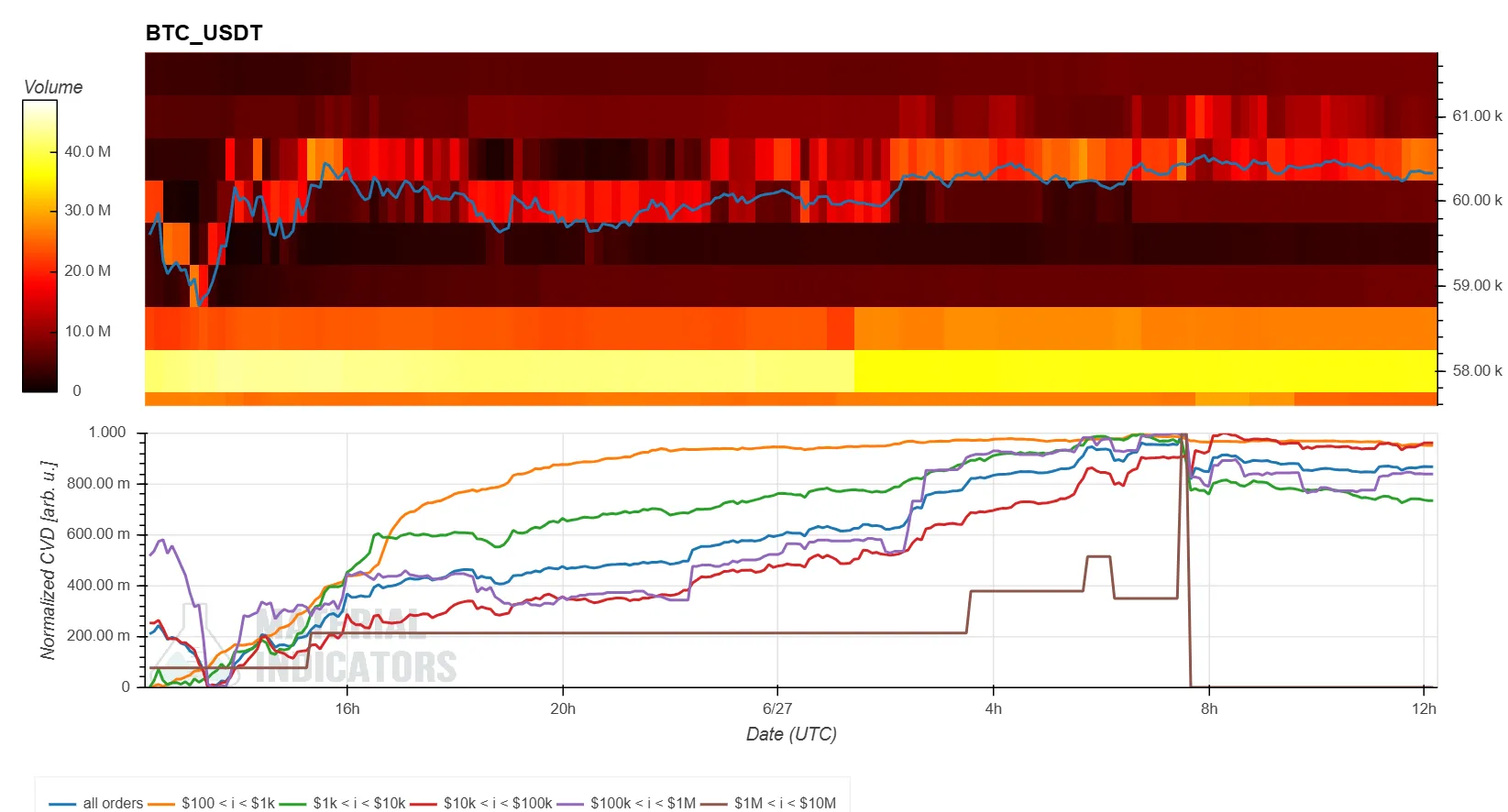
The Spot CVD chart analyzes the order book for the BTC/USDT spot trading pair. The upper section displays a volume heatmap, while the lower section shows the Cumulative Volume Delta (CVD).
- The volume heatmap tracks the scale of trading volume at specific price levels. The background color brightens when the price consolidates within a certain range or experiences a significant move. These brighter areas may act as potential support or resistance levels.
- The Cumulative Volume Delta (CVD) indicator represents buy and sell orders categorized by trade size. As buy orders increase, the corresponding colored line rises. The yellow line tracks orders between $100 and $1,000, while the brown line tracks large orders between $1 million and $10 million.
11:31
Ark Invest CEO Cathie Wood stated on X that capital flowing out of politically and economically unstable countries could become a new growth driver for the Bitcoin (BTC) and digital asset markets. She noted that while artificial intelligence (AI) is currently capturing the investment market's attention and leading technological innovation, it cannot substitute for the role of a store of value that many people seek. Wood predicted that these funds are likely to flow into the cryptocurrency market, driving new investment demand. She has previously offered a five-year price forecast for Bitcoin, with a base case of $750,000 and a bull case of $1.25 million.
11:01
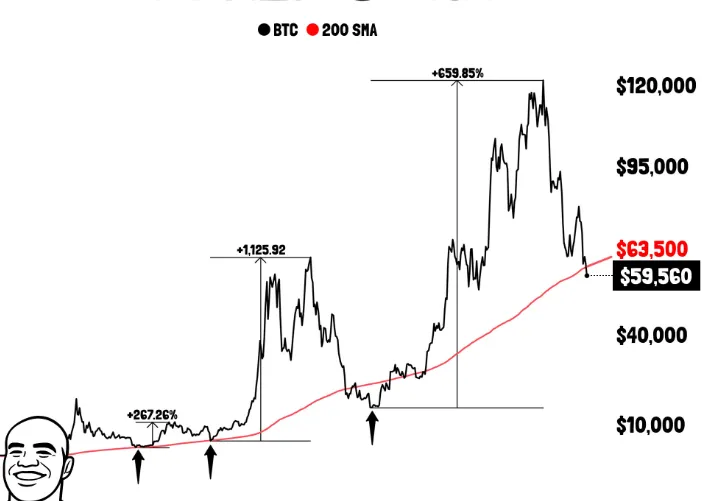
Cryptocurrency trader Ali Martinez said on X that Bitcoin (BTC) has rarely traded below its 200-week simple moving average (SMA) historically. However, he noted that each time it has, the period has offered a favorable accumulation opportunity for long-term investors. Martinez suggested that a dollar-cost averaging (DCA) strategy is worth considering when BTC is trading below its 200-week moving average.
08:36
The European Parliament's Committee on Economic and Monetary Affairs (ECON) has recommended that the European Commission review the need for regulations covering decentralized finance (DeFi), staking, NFTs, and crypto lending services. In a report published on June 27, the committee proposed that these crypto services should be evaluated for inclusion under the EU's Markets in Crypto-Assets (MiCA) regulation. The report also urged the expansion of tokenized financial services and the promotion of euro-based stablecoins.
07:18
An address associated with Ethereum founder Vitalik Buterin transferred 7,000 ETH ($11.06 million) to a new address, according to Onchain Lens. Given the address's past transaction patterns, Onchain Lens noted that the funds are likely to be deposited onto an exchange.
07:08
The Hong Kong government has announced that regulated stablecoins are scheduled to be launched in the second half of this year. According to a written response submitted to the Legislative Council, the Hong Kong Monetary Authority (HKMA) granted stablecoin issuance licenses to two bank-backed institutions in April, and these entities will launch their products in line with their business plans. The government added that it has sent official notices to unlicensed stablecoin issuers outlining legal requirements and plans to submit a bill this year to establish a regulatory framework for virtual asset trading, custody, advisory, and asset management services.
