Live Feed
New
Today, August 25, 2026
20:26
PolymarketUS open interest reached $111 million, nearly doubling since the 2026 FIFA World Cup ended in mid-July, Crypto Briefing reported.
Crypto Briefing said the growth runs counter to the broader prediction market trend, with open interest across major platforms including Kalshi down about 20% since the World Cup ended, while PolymarketUS has continued to rise.
20:18
Markus Thielen, founder of 10x Research, said in an interview he prefers splitting a portfolio evenly between Bitcoin and gold at current price levels, according to Cointelegraph.
Thielen said AI-related stocks are much harder to value now and added he sees a simpler portfolio built around Bitcoin and gold as a better option than betting on AI names in the current market.
20:02
The three major U.S. stock indices closed higher today.
- S&P 500: +0.32%
- Nasdaq: +0.66%
- Dow Jones: +0.30%
20:01
Bitcoin’s rally has been driven by falling Treasury yields, a short squeeze, and renewed optimism over U.S. crypto policy, Forbes reported.
Dave Liebowitz, head of growth at private credit platform Cap, said Bitcoin’s advance appeared to be the result of several factors working at once rather than a rally unique to crypto. He said the macro backdrop had become more supportive for risk assets, while nearly $2 billion flowed into U.S. spot Bitcoin ETFs last week. Improving liquidity conditions and sustained institutional demand combined to push Bitcoin higher արագly, he added, especially as market positioning had been built more defensively.
Paul Howard, senior director at crypto trading firm Wincent, said the initial move higher was led by a short squeeze, with subsequent support coming from U.S. Treasury bond purchases and optimism surrounding the CLARITY Act. That momentum then drew the attention of investors who had previously been focused elsewhere, Howard said, adding that Bitcoin was likely to extend its gains and could reach $100,000 by year-end.
19:30
Binance has hired two compliance executives from Crypto.com, Crypto Briefing reported. Their identities and roles were not disclosed. Crypto Briefing said Binance is reshaping its compliance team after a series of staff departures and years of regulatory pressure.
19:26
BlackRock expects investors to continue investing billions of dollars in Bitcoin, former Bitcoin Magazine editor Pete Rizzo said, citing Bloomberg.
18:27
Digital asset investment firm RockawayX announced plans to raise $150 million for a liquidity fund that will invest in undervalued tokens and crypto-related stocks, according to Forbes.
18:18
10x Research founder Markus Thielen said he does not expect Bitcoin to break to a new all-time high in the near term, although BTC could continue a sizable rally, according to Cointelegraph.
Thielen said $100,000 is an important milestone for Bitcoin and, in itself, a major achievement.
17:55
Japan is considering a pilot real-time settlement system for stocks and bonds using blockchain technology, Walter Bloomberg reported, citing Nikkei. To support the effort, Japan’s Financial Services Agency, the Ministry of Finance, the Bank of Japan, and major financial institutions plan to launch a related study group this summer. A detailed development plan is expected to be drawn up early next year, followed by operations beginning within the next few years and a broader system becoming operational in the early 2030s.
17:21
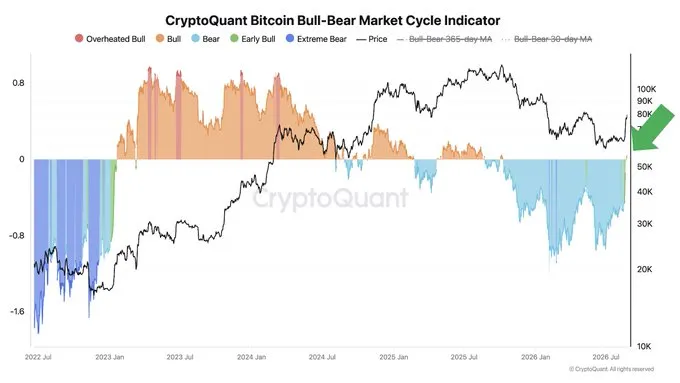
On-chain analyst Julio Moreno said Bitcoin’s market trend has shifted into a bull phase, with most indicators pointing to the early stage of a new upcycle.
Moreno said two factors still warrant caution. For the bull market to be officially confirmed, Bitcoin needs to break above its 365-day moving average, currently at $83,000. Moreno added that a price correction remains possible, given high unrealized profits after the recent surge and potential selling pressure from a sharp increase in exchange inflows. Even so, Moreno said the overall data still signals a highly positive outlook.
16:59
Strategy’s biggest risk is not a decline in Bitcoin itself but whether it can keep tapping capital markets to cover $1.76 billion in annual financing costs, including dividends and interest, Regime Intelligence said in a recent report, according to Cointelegraph.
The report said roughly $22 billion in debt and preferred equity claims sit behind Strategy’s 840,447 BTC holdings. It added that external financing is essential to sustain the company’s Bitcoin accumulation model. Because the structure is not backed by collateralized loans, the report said a drop in Bitcoin’s price would not create a risk of forced liquidation. Under its stress test, Strategy’s Bitcoin holdings and cash deposits would fail to cover convertible notes only if Bitcoin fell by about 96%, it said.
Market analysts advise watching preferred stock price trends and the company’s dollar cash reserves, which currently cover about 2.6 times its annual financing costs.
16:47
Realio Network, a layer-one platform for tokenized real-world assets, halted its chain and blocked access to its web app after about 124.4 million RIO tokens were stolen, Crypto Briefing reported.
Most of the compromised tokens, about 113.7 million RIO, were foundation-held tokens that had not been included in the previous circulating supply. About 10.7 million RIO, or roughly 3.3% of the prior circulating supply, was stolen from user accounts, while about 5.73 million RIO was drained from 2,374 personal accounts before the native chain was shut down. The attacker sold more than 2.5 million RIO on Stellar's DEX. No compensation plan for the 2,374 affected users or token custody measures have been announced.
16:29
Kalshi has signed multiyear partnerships with five major MLB teams — the Los Angeles Dodgers, Boston Red Sox, Atlanta Braves, San Diego Padres and San Francisco Giants — Crypto Briefing reported. The prediction market platform secured rights for in-stadium LED billboard ads, digital and radio promotions, fan events, and naming rights to the Gold Glove Bar at the Dodgers’ home stadium.
Kalshi is also expanding its marketing investment in sports as trading volume for baseball-related prediction contracts on its platform has surged 36-fold from a year earlier.
16:27
XRP Ledger Foundation community leader and validator Vet has unveiled amendments to introduce native lending and privacy features for XRP holders, outlining plans to build an in-house DeFi stack that would operate directly at the network level without external smart contracts or bridges, U.Today reported.
The XLS-65 and XLS-66 amendments cover a native lending protocol, while XLS-0096 addresses privacy and delegation of authority, and XLS-70 covers digital identity verification.
16:24
Bitcoin has entered a bull market phase, according to CryptoQuant. The firm said its proprietary Bull Score jumped to 80 from 30 in a week, marking the fastest increase in a year, and described $83,000 as the last remaining resistance level before a full-fledged uptrend.
16:19
Ki Young Ju, CEO of CryptoQuant, said the Bitcoin bear market is over.
15:59
Uniswap recorded 28.9 million swaps last week, the highest weekly total on record, according to Unfolded.
15:58
Galaxy has launched a crypto-backed portfolio line of credit that lets eligible GalaxyOne clients borrow cash against Bitcoin (BTC), Ethereum (ETH) and Solana (SOL) without selling their holdings, The Block reported.
15:34
Japan-based Bitcoin treasury company Metaplanet transferred 1,000 BTC to Coinbase Prime, Bitcoin News reported. While exchange deposits are typically interpreted as a sign of potential selling, Coinbase Prime is a prime brokerage platform offering trading, custody and financing services to institutional investors, leaving open the possibility of other uses.
15:32
World Liberty Financial CEO Zach Witkoff pushed back in a CNBC interview against allegations of conflicts of interest and preferential treatment surrounding the project. Witkoff said concerns that companies or governments were using the USD1 stablecoin to channel money to President Donald Trump’s family were not true.
Witkoff said USD1 has more than $4 billion in circulation and records more than $1 billion in daily trading volume, which Witkoff described as evidence of use by real transactors. Witkoff also said Zach Witkoff has never discussed business matters with President Trump and will not do so in the future.
Democratic lawmakers, meanwhile, continue to raise the possibility of foreign policy-linked conflicts of interest, citing a UAE-linked group’s acquisition of a 49% stake in World Liberty Financial and income tied to the project for the Trump family.
15:08
Strive’s perpetual preferred stock SATA raised enough funding in an hour today to buy 75 BTC, BTC Treasury reported. Strive added 1,110 BTC last week.
15:06
World Liberty Financial (WLFI) said its stablecoin USD1 will be issued natively on Canton Network.
14:57
Kraken received about 12,000 small-value deposits, or a dusting attack, from a wallet linked to HTX, formerly Huobi, Bloomberg reported. Some user accounts were temporarily frozen under compliance review procedures, but access has since been fully restored while funds subject to sanctions remain blocked.
HTX denied carrying out the transfers directly and said it is investigating whether the wallet address was misidentified or whether a third party acted maliciously.
14:44
Anthony Pompliano, founder of crypto-focused investment firm Pompl Investments, said in an appearance on Fox News that Bitcoin will rise sharply. He added, "미국 정부는 절대 돈을 찍어내는 것을 멈추지 않을 것이다. 정부가 계속 돈을 찍어내는 한 비트코인 가격은 계속해서 오를 것."
14:39
THORChain, a cross-chain decentralized exchange, has announced the THORChain 3.20 protocol upgrade centered on support for native swaps of Monero (XMR) and Zcash (ZEC), Decrypt reported.
The upgrade will allow privacy coins whose market presence had narrowed amid delistings by centralized exchanges and tighter regulation to be swapped directly for Bitcoin (BTC), Ethereum (ETH), and stablecoins without conversion into wrapped assets or the use of CEX accounts and custodial procedures.
