Live Feed
New
Today, August 7, 2026
01:06
HyperLabs, the development team behind Hyperliquid, is estimated to have deposited 433,000 unstaked HYPE worth $24.25 million to exchanges via crypto market maker Flowdesk, AmberCN reported. Exchange deposits are typically seen as intended for selling.
00:54
Pump.fun deposits $6.3M in SOL to Kraken for fee monetization
00:49
Bitcoin miners continue transferring BTC to NYDIG
Bitcoin miner MARA deposited 200 BTC worth $12.86 million to crypto lender New York Digital Investment Group (NYDIG) 10 hours ago, according to Lookonchain. Riot Platforms also deposited an additional 381 BTC worth $24.51 million to NYDIG 10 hours ago.
00:45
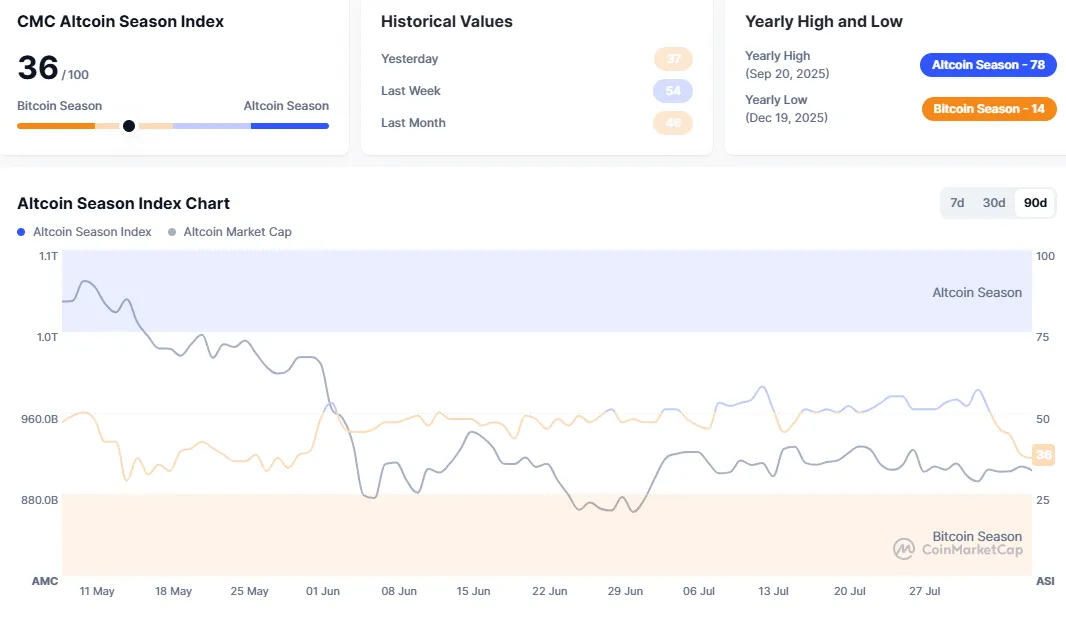
CoinMarketCap’s Altcoin Season Index fell nine points from yesterday to 36. The index compares the price performance of Bitcoin with that of the top 100 coins by market capitalization, excluding stablecoins and wrapped coins. It is considered altcoin season when 75% of those top 100 coins have outperformed Bitcoin over the past 90 days, while the opposite is considered Bitcoin season. A reading closer to 100 indicates altcoin season.
00:28
A wallet believed to be linked to crypto market maker Amber Group withdrew five tokens worth about $9.97 million from Binance around six hours ago, AmberCN reported. The assets included 38.89 million ENA ($3.58 million), 28,262 AAVE ($2.52 million), 1,140 ETH ($2.18 million), 2,017 BNB ($1.20 million), and 59,202 LINK ($490,000). Exchange withdrawals are typically interpreted as a move to hold the assets.
00:12
Plume said on X it has joined the Digital Assets Solutions industry working group under the Depository Trust & Clearing Corporation, or DTCC. The group also includes major financial and fintech companies such as Charles Schwab, Alpaca and Nasdaq. It serves as a channel for gathering industry feedback on DTCC’s tokenization services and promoting broader use of digital assets and technological innovation. DTCC is a global post-trade infrastructure operator overseeing more than $114 trillion in assets and plays a central role in financial market settlement and asset services. Plume said it plans to take an active part in the working group based on its expertise in regulatory compliance.
00:11
Thailand’s Finance Ministry will exempt capital gains tax on cryptocurrency trades for five years from Jan. 1, 2025 through Dec. 31, 2029.
The tax break applies only to transactions conducted through exchanges, brokers, and dealers licensed by Thailand’s SEC. Other crypto-related income, including mining and staking, remains subject to tax.
00:04
Coinbase CEO urges U.S. Senate to hold CLARITY vote
00:04
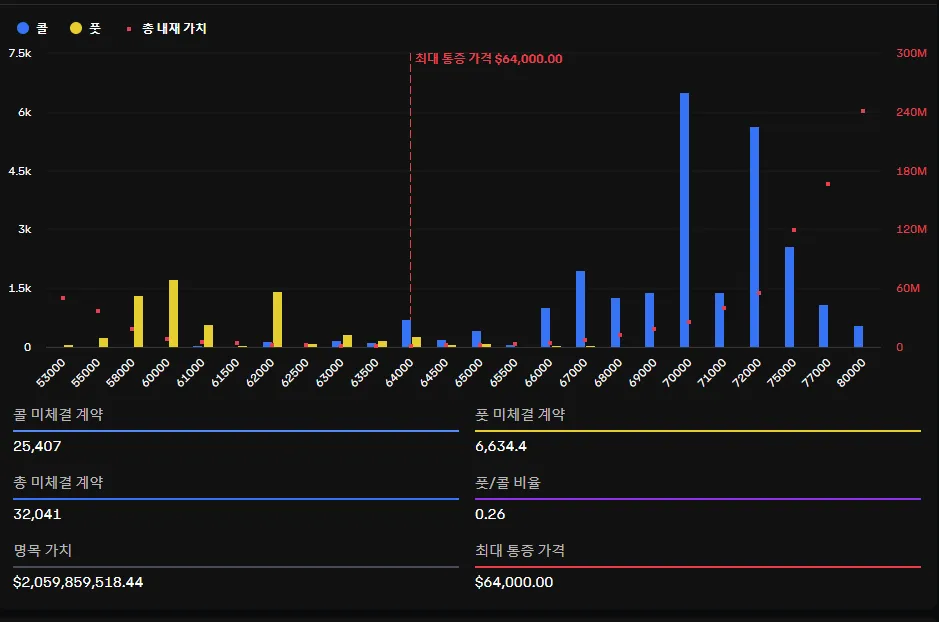
Around $2 billion in Bitcoin options will expire at 8:00 a.m. UTC today on Deribit, with a put-to-call ratio of 0.26 and a max pain price of $64,000, according to the crypto options exchange.
At the same time, around $330 million in Ethereum options will also expire, with a put-to-call ratio of 0.76 and a max pain price of $1,900.
00:02
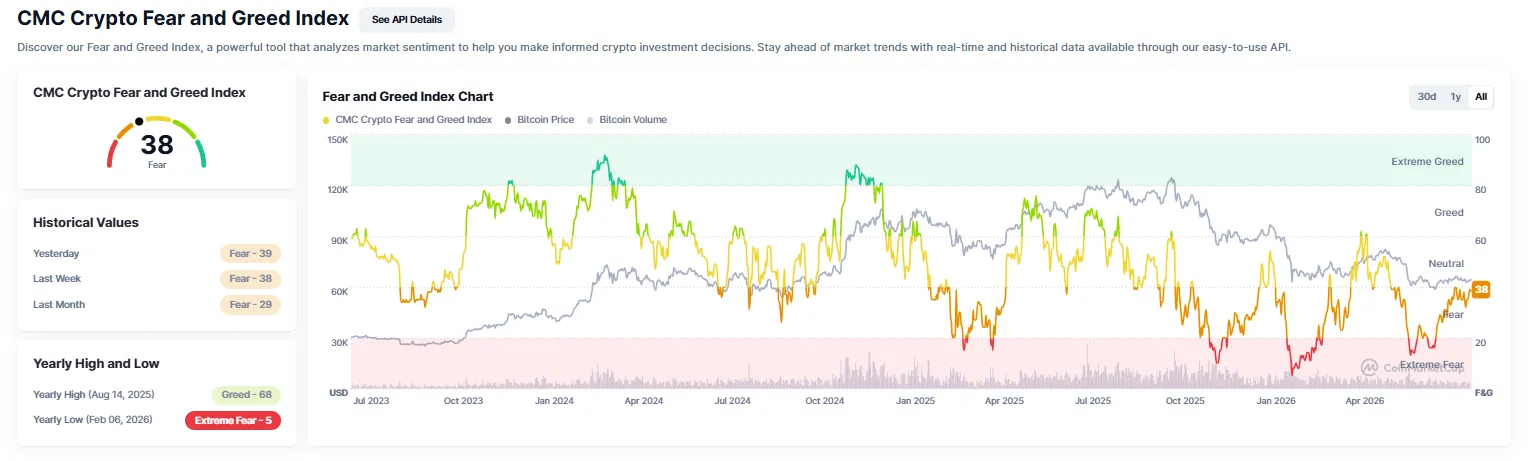
CoinMarketCap’s proprietary Crypto Fear and Greed Index came in at 38, down one point from yesterday, with the market remaining in the fear zone.
A reading closer to zero indicates extreme fear, while a reading closer to 100 signals extreme optimism. According to CoinMarketCap, the index is calculated based on price moves among the top 10 cryptocurrencies by market capitalization, market volatility, derivatives-market indicators including the put-call ratio, the stablecoin supply ratio, and CoinMarketCap’s own search data.
Yesterday, August 6, 2026
23:38
Aster’s yield-generating stablecoin USDF has posted an annual percentage yield of up to 15.30%, according to CoinNess monitoring. The figure combines a deposit yield of 0.8% and a trading-activity yield of 14.5%.
USDF is a stablecoin launched by the decentralized perpetual futures exchange Aster. Its reserves are backed 100% by USDT, with swaps supported at a 99.99% ratio. The token can also be used as collateral for perpetual futures trading on Aster.
Aster is currently offering weekly USDF rewards that are automatically paid to users who hold at least one USDF, trade at least twice a week, and reach cumulative trading volume of 50,000 USDT.
23:14
Crypto industry-backed political action committee Fairshake affiliates Defend American Jobs and Protect Progress have spent more than $1.5 million on ads supporting House and Senate candidates in Florida, Alaska and Wyoming, Cointelegraph reported. Many of the candidates backed by the groups voted in favor of the CLARITY Act in Congress.
Earlier, Protect Progress spent more than $2 million backing incumbent Democratic U.S. Rep. Shri Thanedar in Michigan’s Democratic House primary, but Thanedar lost to state Rep. Donavan McKinney.
23:12
Cointelegraph analyzed that while Bitcoin mining companies are expanding the scale and value of contracts tied to AI infrastructure, the stock market’s reaction has become more muted than before. The outlet said shares of miners previously posted sharp gains simply on news of moves into AI and high-performance computing, but recently, even announcements of large-scale contracts have produced only limited upside.
22:09
Bloomberg reported that Republican Sen. Thom Tillis and Democratic Sen. Ruben Gallego have proposed an ethics provision for the CLARITY Act that would require President Donald Trump to divest his stakes in cryptocurrency-related businesses to help advance the bill in the Senate. If Trump were to sell those holdings under the provision, however, he could defer federal taxes on capital gains for years or, in some cases, effectively avoid them, potentially yielding tax savings worth millions of dollars. Bloomberg added that the proposal would also give state attorneys general the authority to enforce the ethics provision, which it described as a key sticking point in the Senate’s push to pass the CLARITY Act.
21:21
Bitcoin miners MARA Holdings and CleanSpark posted sharp revenue declines and net losses as mining profitability weakened, The Block reported.
MARA Holdings recorded second-quarter revenue of $174.9 million, down 27% from a year earlier, while CleanSpark reported fiscal third-quarter revenue of $138.0 million, down 30.5%. MARA posted a net loss of $611.3 million, affected by digital asset valuation losses, and CleanSpark reported a net loss of $239.8 million. Against that backdrop, The Block said both companies continue to expand their high-performance computing and AI infrastructure businesses.
21:17
Circle’s head of EU policy Patrick Hansen said many major stablecoins, including Tether’s USDT, do not meet regulatory requirements after the EU’s Markets in Crypto-Assets regulation fully took effect, limiting access for EU users.
Hansen said only USDG, USDC and EURC currently comply with MiCA requirements, making it difficult for EU users to access other major stablecoins or leaving them without regulatory protections. He added that MiCA’s future review process should establish more practical compliance measures for offshore issuers.
21:06
An early Bitcoin whale that accumulated BTC when it was trading at $10-$15 moved 50 BTC, worth about $3.22 million, to a new address for the first time in about 10 months, Onchain Lens reported. Onchain Lens said the transfer may indicate preparations for an over-the-counter sale, adding that wallets linked to the whale had shown similar patterns in the past before sending funds to FalconX or centralized exchanges.
20:51
A recent ethics-related draft of the CLARITY Act sent to the White House includes a provision requiring the president to divest crypto-related business holdings, Bloomberg reported.
20:43
Microsoft warned hackers are using BNB Chain to distribute malware in a way that makes malicious infrastructure harder to take down.
According to the report, the method involves compromising legitimate websites and inserting malicious JavaScript that communicates with smart contracts deployed on BNB Chain, then retrieves next-stage payloads from the contracts through BNB Smart Chain RPC gateways. Microsoft said the malware can only be modified or deleted by the wallet holder that deployed the contract.
20:26
Wintermute has obtained a U.S. broker license from regulators and plans to trade commodities, crypto ETFs and tokenized stocks subject to regulatory approval, The Wall Street Journal reported. The license also gives Wintermute USA designated market maker status on exchanges including the New York Stock Exchange and Nasdaq. The newspaper said the move marks a crypto company’s entry into regulated Wall Street and lays the groundwork for an expansion into traditional financial services.
20:12
Nine Democratic U.S. senators urged the Commodity Futures Trading Commission to ban prediction market contracts tied to whether wildfires occur, Decrypt reported. In a letter to CFTC Chairman Michael Selig, the senators, including Jeff Merkley, warned "산불 관련 예측시장 계약" could encourage arson, enable insider trading and threaten public safety. They argued the CFTC should regulate wildfire-related betting before next year’s wildfire season begins.
20:02
The three major U.S. stock indices closed lower today.
- S&P 500: -0.18%
- Nasdaq: -0.06%
- Dow Jones: -0.85%
20:01
Nathan Allman, the late founder of Ondo Finance (ONDO), is at the center of a dispute over control of the company, with Allman’s mother seeking control and calling for CEO Ian De Bode’s removal. The Block, citing a complaint filed in a Delaware court, reported Allman’s mother alleged that within days of her son’s death, De Bode acted as Ondo Finance’s CEO without board approval and tried to appoint himself as the company’s sole director. Allman’s mother argued that as administrator of her son’s estate, she holds the voting rights tied to the company and has the authority to reconstitute its board. De Bode pushed back, saying the claims are baseless and will be clearly disproven in court. Ondo Finance had announced in late May that Allman had died and that De Bode had become CEO.
18:25
Vangrid, a decentralized physical infrastructure network project, has raised $9 million in seed funding, The Block reported. Participants in the round included HashKey, Borderless Capital, Crypto.com, Animoca Brands, Gate Labs and Mapleblock Capital. Vangrid is developing a smartphone-based 3D spatial data collection and on-chain verification network solution. The funding will be used to expand its data network and broaden AI infrastructure partnerships. The company also plans to launch its native token in the second half of this year and introduce a rewards mechanism.
17:25
A Greek security researcher spent about 22 months infiltrating servers used by a North Korean hacking group and monitoring its activities, confirming that 1,640 organizations, including Coinbase and Uniswap Labs, had been targeted, according to BeInCrypto.
Among the 1,640 organizations, about 700 to 800 were found to be seriously compromised, with the hackers having obtained access to server root privileges, AWS root accounts and cryptocurrency wallet keys, BeInCrypto reported. The researcher said the notable point was that although the North Korean hackers had access to medical records and criminal databases, they barely touched them and instead focused on cryptocurrency wallets and blockchain access rights. The researcher added that warning messages were sent to Coinbase and Uniswap Labs, which were known to have responded.
