Live Feed
New
Today, July 16, 2026
10:43
Shares of Bitcoin mining company Terawulf (Nasdaq: WULF) fell 7% after U.S. President Donald Trump urged New York state to immediately lift its one-year moratorium on permits for new large data centers, The Block reported. President Trump stressed the need for a policy change, describing data centers as money-making machines. However, Terawulf stated that its existing operations and development plans in New York are unaffected.
10:33
Orange Juice, a company backed by Vancouver-based Bitcoin supporter Jeff Booth and macroeconomist Lyn Alden, has raised $40 million to launch a Bitcoin accumulation company, The Block reported. The new firm, to be established in Connecticut, U.S., plans to pursue a strategy of acquiring companies with stable cash flow and allocating the profits to purchase Bitcoin.
10:11
India's Enforcement Directorate (ED) has seized 33.5 million rupees ($401,000) in cryptocurrency and 1.45 million rupees in cash as part of a money laundering investigation into online investment and work-from-home scams, The New Indian Express reported. Authorities also froze bank accounts containing over 4 million rupees.
The agency conducted raids at 19 locations, including in Tamil Nadu, on July 10-11, securing documents, digital devices, and bank records. The investigation found that a cyber fraud ring defrauded victims of 149.5 million rupees by promising high returns through fake investment platforms and remote job offers. The funds were then laundered through multiple mule accounts and shell companies, converted into cryptocurrency, and distributed across various wallets to conceal the money trail.
10:10
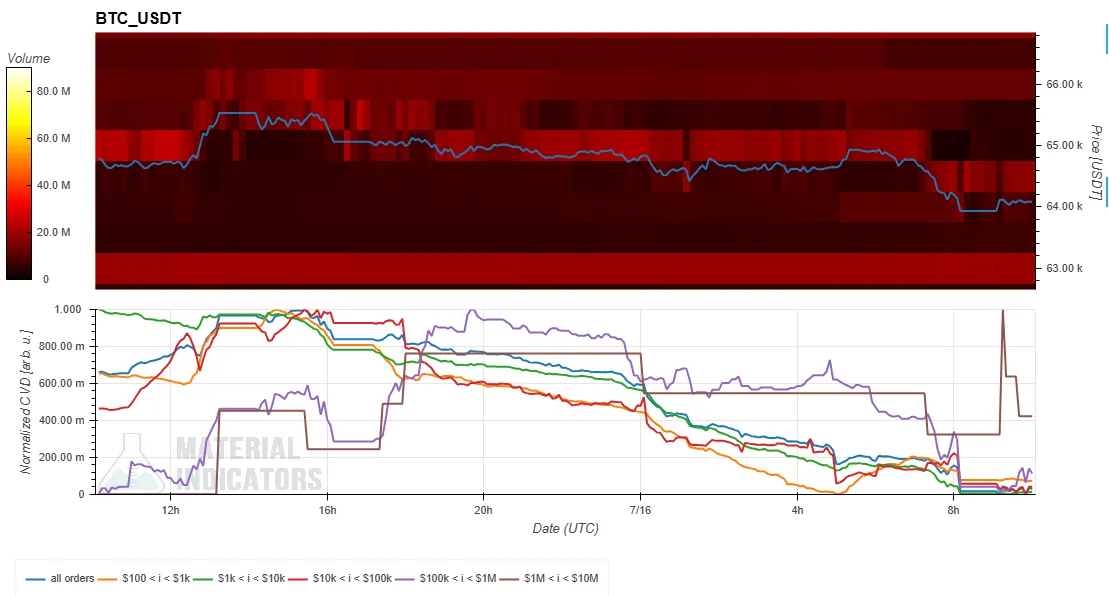
The spot Cumulative Volume Delta (CVD) chart is an order book analysis tool for the BTC/USDT spot pair. The top section shows the Volume Heatmap, while the bottom section displays the CVD.
- The Volume Heatmap tracks trading volume at specific price levels. Brighter areas, where the price has lingered or moved significantly, may act as potential support or resistance.
- The CVD indicator represents buy and sell orders categorized by trade size. A rising line indicates an increase in buy orders. The yellow line represents orders from $100 to $1,000, and the brown line represents large orders from $1 million to $10 million.
10:03
Bitcoin Treasury Capital (BTCB) announced via X that it has received approval to launch "BTC PREF," Sweden's first preferred stock backed by Bitcoin (BTC). The stock, which offers a 10% annual dividend, will begin trading on the Spotlight Stock Market on July 20.
09:54
The market is shifting from being speculation-driven to an accumulation phase led by institutions and long-term investors, according to an analysis by CryptoQuant contributor TopNotchYJ, as reported by The Crypto Basic. The analyst noted that BTC's Spent Output Profit Ratio (SOPR) is approaching one, which signifies a balance between buying and profit-taking. Additionally, a decrease in exchange holdings suggests that BTC is moving to ETFs and institutional custody. The risk of large-scale liquidations has also been mitigated, as the estimated leverage ratio and open interest (OI) are significantly lower than at previous highs. TopNotchYJ concluded that the market is currently being driven by steady accumulation from institutions and long-term investors rather than short-term speculation.
09:43
On-chain analyst ZachXBT has advised against using cryptocurrency hardware wallets, recommending a dedicated iPhone for such purposes instead. Writing on his Telegram channel, he stated that all hardware wallets are "useless" and should not be used for critical tasks like signing transactions or storing funds. He argued that it is much better to use a separate iPhone exclusively as a hardware wallet. ZachXBT singled out Ledger as "the worst" among hardware wallets, criticizing Ledger Live for its frequent and seemingly unnecessary UI and app updates that he claims often prevent simple actions from being executed.
09:25
Swedish truck manufacturer Volvo Group is testing its own cryptocurrency for use in its supply chain payment system, Crypto Briefing reported. According to Ivan Branco, Head of Information Management at Volvo Group, who appeared on a Cardano Foundation (ADA) podcast, the company is conceptualizing a system to record payments and order ledgers between material suppliers and transporters on a shared blockchain. This system would use a cryptocurrency for instant settlements within the supply chain, bypassing traditional banking networks. The cryptocurrency is designed for internal supply chain payments rather than as a public, speculative token. The specific blockchain to be used has not been disclosed, and there is no officially announced partnership with the Cardano Foundation.
09:24
Tether, the issuer of the USDT stablecoin, has invested $20 million in Argentine neobank Ualá as part of its expansion into Latin America, Cointelegraph reported.
09:00
Swedbank AB, one of Sweden's leading banks, has purchased an additional 8,278 shares of Strategy (Nasdaq: MSTR), a firm known for its Bitcoin accumulation strategy. This brings the bank's total holdings to 90,590 shares, Crypto Briefing reported.
08:45
Kwak Hyun-joon, currently the senior staff member for the Land, Infrastructure and Transport Committee, has been appointed as the new senior staff member for the National Assembly's National Policy Committee, which oversees the financial sector, including virtual assets. According to Digital Asset, National Assembly Speaker Cho Jung-sik announced the appointment of 13 senior staff members today, with the changes taking effect on July 20. Senior staff members are responsible for professionally reviewing and analyzing legislation and policies under their committee's jurisdiction.
08:37
According to Coinglass data, an estimated $1.01 billion in short positions on major centralized exchanges (CEX) will be liquidated if BTC breaks through $66,186. Conversely, a drop below $63,526 would trigger the liquidation of $298.46 million in long positions.
08:33
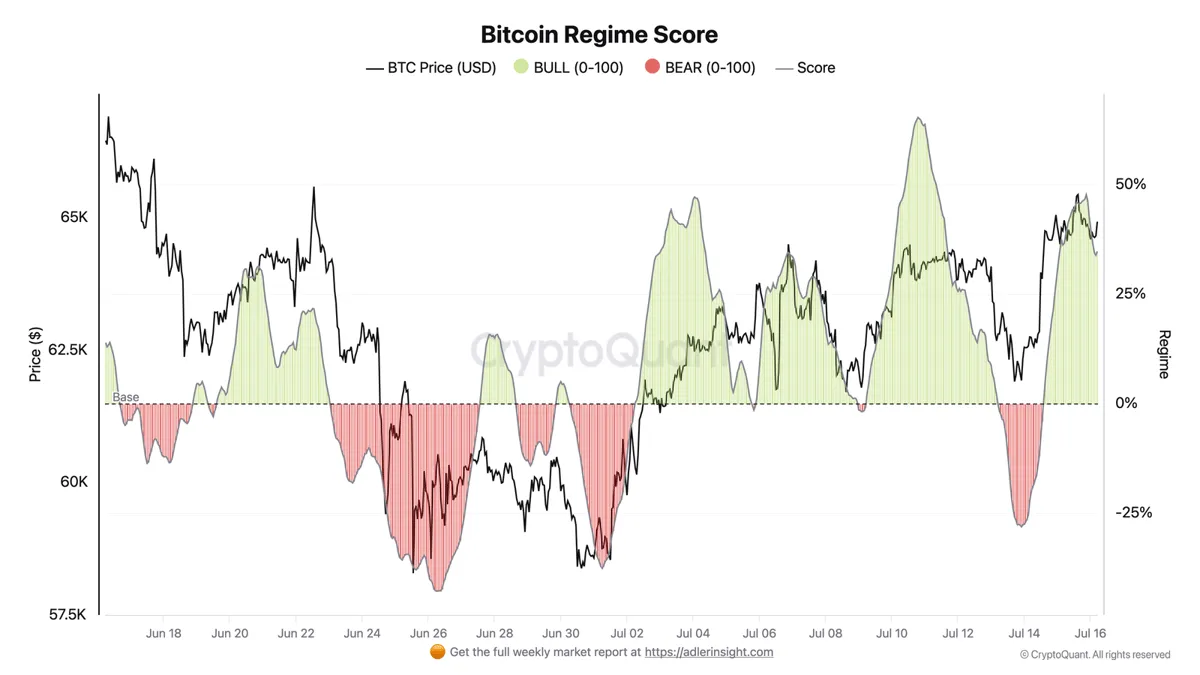
The Bitcoin market trend has shifted from bearish to bullish over the past two weeks, with increased alignment among various indicators, according to on-chain analyst Axel Adler Jr. In a blog post, Adler noted that his Regime Score, a composite market direction indicator, is currently at a moderate +34.7, having remained in positive territory for about 80% of the past week. He added that the accompanying Regime Confidence metric is at 79.4%, well above the monthly average of 57.3%, indicating higher reliability for the bullish signal. Adler explained that the trend would be further confirmed if the score reaches +50 with confidence holding near 80%. However, he warned the trend could collapse if the score drops below zero for more than 24 hours and confidence falls below 40%. The Regime Score synthesizes data from taker flows, open interest, funding rates, ETF flows, exchange activity, and price trends to gauge market direction on a scale of -100 to +100.
08:14
According to CoinNess market monitoring, BTC has fallen below $64,000. BTC is trading at $63,991.98 on the Binance USDT market.
08:07
South Korean crypto exchange Bithumb has announced plans to delist Gracy (GRACY), Tottenham Hotspur (SPURS), ZTX (ZTX), WIKEN (WIKEN), and Step App (FITFI) at 6:00 a.m. UTC on Aug. 18. According to the announcement, the decision was made because the issues that led to the assets being placed under an investment warning have not been resolved.
07:51
DeltaDeFi, a decentralized exchange (DEX) built on Cardano's (ADA) Layer 2 solution Hydra, is indefinitely suspending its services due to operational difficulties, The Crypto Basic reported. User refunds will be processed as soon as the necessary funds for withdrawals are secured. Several other Cardano-based applications, including JPG Store and TapTools, have also ceased operations this year.
07:43
Binance founder Changpeng Zhao said on X that while AI is great, it cannot protect against inflation, whereas Bitcoin can.
07:31
South Korean financial officials specializing in virtual assets are increasingly moving to major law firms, News1 reported. Recently, major law firms, including Kim & Chang, Lee & Ko, Yulchon, and Yoon & Yang, have been bolstering their expertise by consistently hiring specialists from both regulatory bodies and the virtual asset industry. The move comes as the industry anticipates a growing demand for regulatory compliance from financial companies and virtual asset service providers as the country's formalization of its crypto legal framework accelerates.
07:23
The Ethereum Foundation will hold a luncheon meeting with officials from major South Korean financial institutions in Yeouido, Seoul, on July 21, ZDNet Korea reported. Attendees are expected to include representatives from the Korea Financial Investment Association, Koscom, the Export-Import Bank of Korea, and DB Financial Investment. The foundation is anticipated to discuss Ethereum's technical advantages and security as a financial infrastructure, as well as potential adoption strategies.
07:12
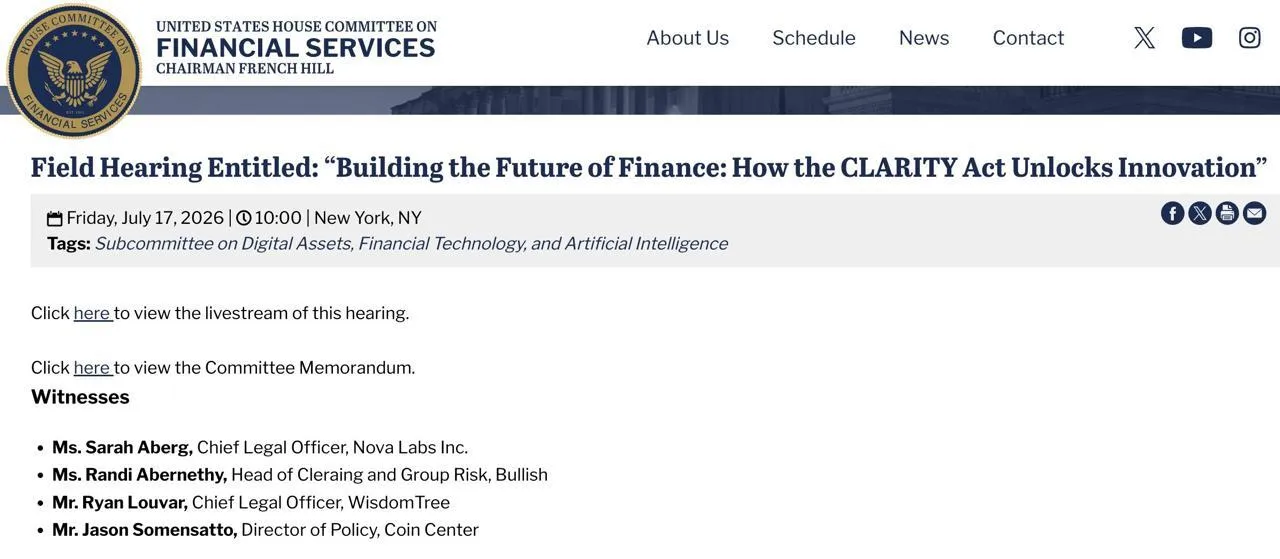
The U.S. House Financial Services Committee is scheduled to hold a field hearing at 2:00 p.m. UTC on July 17 to discuss the impact of the CLARITY Act on financial innovation. The bill passed the Senate Banking Committee in May and now awaits a full Senate vote and reconciliation with the House. Industry observers view the bill's core as its ethics provisions aimed at preventing conflicts of interest related to the Trump family's cryptocurrency businesses, and see the period before the August congressional recess as the final deadline for its passage.
07:09
The U.S. Senate has unanimously passed a non-binding resolution stating that FTX founder Sam Bankman-Fried (SBF) should not receive a presidential pardon or have his sentence commuted, CoinDesk reported. Although U.S. President Donald Trump said in January that he had no plans to pardon SBF, speculation about the possibility arose after he previously pardoned Binance founder Changpeng Zhao and Silk Road founder Ross Ulbricht. SBF was convicted in November 2023 on seven charges related to the collapse of FTX, with damages estimated to be over $8 billion. The U.S. Department of Justice has described the case as one of the largest financial frauds in U.S. history.
07:03
South Korean crypto exchange Coinone announced that it has designated 12 tokens for its delisting watchlist: Streamr (DATA2), Nestree (EGG), StaFi (FIS), Hifi Finance (HIFI), Mon Protocol (MONPRO), FanC (FANC), dELABS Games (DELABS), Saros (SAROS), Xpass (XPASS), AgentLisa (LISA), Sperax (SPA), and Galaxia (GXA).
07:01
South Korean crypto exchange Bithumb announced that it has placed Azit (AZIT), Cudis (CUDIS), Fancy (FANC), Temco (TEMCO), Nestree (EGG), and Stat (STAT) on its delisting watchlist.
06:12
The following are the 24-hour long/short ratios for BTC perpetual futures on the world’s three largest crypto futures exchanges by open interest:
Overall: 51.28% long, 48.72% short
- Binance: 52.33% long, 47.67% short
- OKX: 51.69% long, 48.31% short
- Bybit: 51.72% long, 48.28% short
06:01
South Korean crypto exchange Coinone has announced that it is removing THORChain (RUNE) from its delisting watchlist.
