Live Feed
New
Today, October 9, 2026
01:40
Animoca Brands announced a strategic partnership with global asset manager Franklin Templeton to expand real-world asset tokenization. The two companies plan to improve institutional investors’ access to tokenized assets through NUVA, an RWA vault marketplace jointly developed by Animoca Brands and Nuva Labs.
01:03
Crypto influencer Bando analyzed that the top 25 token issuers on Solana-based memecoin launchpad PUMP have so far issued around 770,000 tokens and generated a combined $128 million in profit.
00:54
According to the U.S. Attorney’s Office for the Northern District of Illinois, Empire Market co-founder Rahim Hamilton was sentenced to 40 years in prison and fined $5 million on charges of conspiracy to distribute narcotics. Hamilton also agreed to forfeit about 1,230 BTC, 24.4 ETH, and three properties.
Empire Market operated from 2018 to 2020 and processed more than $430 million in transactions, requiring cryptocurrency payments for all trades. Another co-founder, Thomas Pavey, also agreed to forfeit about 1,584 BTC and other assets, and is set to be sentenced later this month.
00:50
South Korean exchange Bithumb announced it would temporarily suspend withdrawals of Tether (USDT) on the Aptos network at 12:00 a.m. UTC today for wallet system maintenance.
00:46
An anonymous whale saw 28,716 ETH in long positions, worth about $69.69 million, liquidated during the recent crypto market plunge, according to Lookonchain. The whale has continued building additional ETH long positions after the liquidation and now holds 78,955 ETH in longs worth about $195.57 million. The liquidation prices for the positions are $2,299.09 and $2,286.28, respectively.
00:32
Hong Kong crypto exchange OSL Group has launched the market-neutral fund token PrimePlus SPC-USDGO Plus SP in partnership with digital asset technology firm 2WA, NewsBTC reported. OSL is responsible for tokenizing fund shares and providing custody for USDGO, the underlying asset, and will offer the product to qualified professional investors in Hong Kong.
00:27
Bitcoin-based life insurer Meanwhile has raised $37.5 million in a funding round led by Bain Capital Crypto, Axios reported. The round also included Hon Ventures, Framework, Pantera Capital and Apollo Global, bringing the company’s total funding to more than $180 million. The proceeds will be used to meet demand for BTC-denominated life insurance in Asia, Europe and the Middle East.
00:21
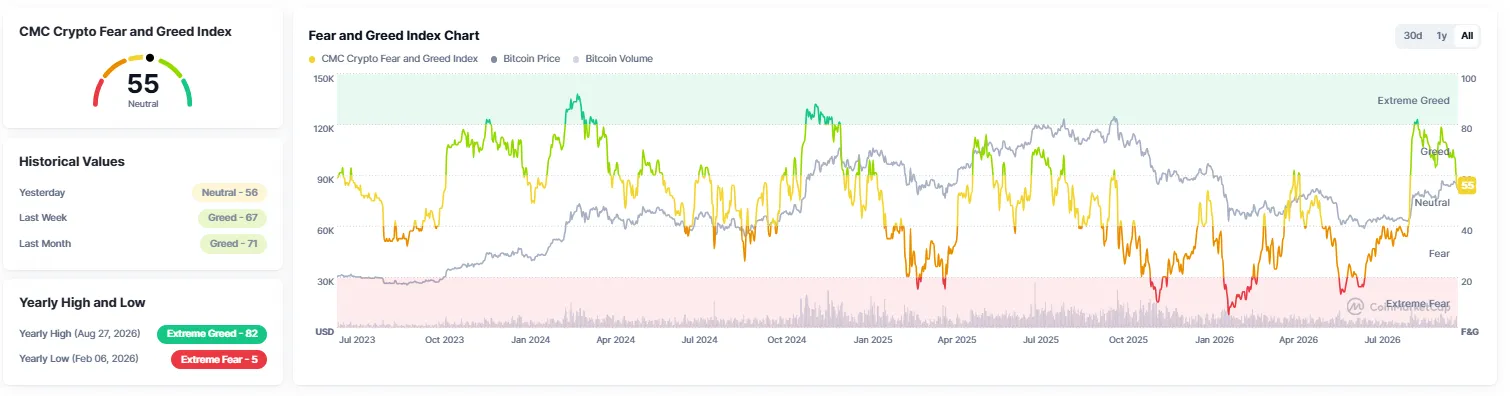
CoinMarketCap’s in-house Crypto Fear and Greed Index came in at 55, down six points from yesterday and shifting from greed to neutral.
The index indicates extreme fear when it approaches zero and extreme optimism when it nears 100. CoinMarketCap calculates the gauge based on price moves among the top 10 cryptocurrencies by market capitalization, market volatility, derivatives-market indicators such as the put-call ratio, the stablecoin supply ratio, or SSR, and CoinMarketCap’s own search data.
00:18
Jump Crypto’s Firedancer wallet has staked an additional 453,987 SOL, worth about $49.81 million, according to Onchain Lens. Firedancer is a Solana validator client developed by Jump Crypto.
00:12
Tokenizing financial assets and fund flows, including Treasuries, stocks and money market funds, could make collateral transfers more efficient and unlock tens of billions of dollars in tied-up capital, Nasdaq CEO Adena Friedman said at the Token2049 event in Singapore, CNBC reported.
Friedman said institutional interest in tokenization has risen since passage of the U.S. GENIUS Act. Friedman added a shift to 24-hour trading would require real-time risk and collateral management systems, with AI set to play a key role, while noting not all assets have the liquidity needed for around-the-clock trading.
Yesterday, October 8, 2026
23:52
BCH has fallen by 4.11% in the past five minutes on the COINNESS market. Currently, BCH is trading at $272.63.
23:50
BitMEX co-founder Arthur Hayes said on X, "대규모 강세장 초기에는 시장이 우려의 벽을 넘어야 한다." He cited the 2017 Bitcoin block size debate, the 2020 COVID-19 shock, the 2023 FTX collapse and central bank rate hikes, and 2026 fears, uncertainty and doubt tied to AI and crypto as major sources of market चिंता at the time. Hayes added, "돈은 계속 풀릴 것이고, 암호화폐 가격은 급등할 것," signaling a bullish view tied to expanding liquidity.
22:52
Bitcoin holders posted about $1.03 billion in daily realized profit, the second-highest level this year and close to the annual peak of $1.04 billion, according to on-chain analytics firm Santiment.
The jump came after BTC recently broke above $87,000, driving a sharp increase in profit-taking. Santiment said large-scale profit-taking often appears during short- and mid-term market correction phases and can increase selling pressure, but it does not necessarily signal a trend reversal.
22:47
A significant share of Bitcoin with exposed public keys stems from address reuse, and that amount is rising, according to on-chain analytics firm Glassnode. Over the past year, BTC held in reused addresses increased about 14.2% to 4.33 million from 3.79 million, equivalent to 21.5% of Bitcoin’s circulating supply. Reusing Bitcoin addresses can increase the likelihood of public key exposure, potentially making those holdings more vulnerable to future quantum computer attacks.
22:35
The U.S. AI industry has copied the crypto sector’s political fundraising strategy, but the results have fallen short of expectations, according to a Crypto Briefing analysis.
The AI industry super PAC Leading The Future has raised about $140 million and spent $55.7 million through late September. Still, it has delivered few signature wins, Crypto Briefing said, pointing to the defeat of a candidate who received more than $8 million in support in a New York state House primary in June. By contrast, crypto industry super PAC Fairshake is focused on backing candidates who support the CLARITY Act and has more than $120 million in cash ahead of the 2026 U.S. midterm elections.
22:31
Aptos Labs has launched a private beta for Shelby, a decentralized storage platform developed with Jump. The company said Shelby is optimized for AI workloads and targets sub-second data read speeds. Three companies are already using the platform in live operations. Shelby verifies data integrity through Aptos smart contracts, while APT is used for network transaction fees and related functions.
22:18
U.S. Sen. Richard Blumenthal, the top Democrat on the Senate Permanent Subcommittee on Investigations, has opened an inquiry into financial ties between Cantor Fitzgerald and stablecoin issuer Tether, CoinDesk reported. In a letter to Cantor Fitzgerald CEO Brandon Lutnick, Blumenthal requested materials on Tether’s reserve custody relationship and its anti-money laundering and sanctions compliance systems. He also asked the firm to explain what steps it took to examine allegations that Tether was used in Iran’s informal financial networks and to evade sanctions on Russia, according to the report.
22:13
Cyber Capital founder Justin Bons has questioned the decentralized structure of the XRP Ledger, U.Today reported.
Bons said XRPL had operated for about two weeks without publicly releasing security-related source code, and the update is set to become effectively mandatory starting today. XRP Ledger developers have said they will release the source code for security-sensitive changes later. Bons also argued the recommended validator list, or UNL, provided by Ripple and others exerts excessive influence over network consensus, adding that selling XRP as a decentralized asset is a blatant fraud.
22:04
BNY said it will expand cryptocurrency custody services for select institutional clients in the European Union after its European banking entity, The Bank of New York Mellon SA/NV, was added to the European Securities and Markets Authority's MiCA register earlier this year. The move allows BNY to provide crypto custody, administration and transfer services to eligible clients in the EU. As of the end of June, BNY held $62.6 trillion in assets under custody and administration.
20:55
Wall Street tokenization could open a major new market for crypto, with some companies and projects potentially benefiting more than Bitcoin and Ethereum, according to a Citrini Research report cited by CoinDesk.
Citrini Research said moving traditional financial assets such as stocks and bonds onto blockchains would create new business opportunities in trading, lending and payments. The firm added the structural flexibility of tokenization could create new markets for trading platforms, lenders, stablecoin issuers and companies that manage securities ownership records. It said the biggest beneficiaries are likely to be companies and crypto protocols that generate recurring fees as tokenized assets are traded, lent and used for payments.
The report named Securitize, Coinbase, Robinhood and Circle as companies that could benefit if Wall Street financial assets move on-chain. It also cited Figure, SoFi and Bullish as candidates to gain from broader tokenization. Among crypto tokens, it highlighted Aerodrome, Maple, Ondo, Pendle and Derive.
20:44
European institutional investors have been buying cryptocurrencies on price dips despite market volatility, 21Shares President Duncan Moir said at the Longitude conference in Singapore, according to Cointelegraph. Moir added that investment flows in Europe have remained relatively stable, supported by regular dollar-cost averaging and similar strategies.
20:37
Coinbase announced it will halt trading in Balancer (BAL) and Tensor (TNSR) at 2:00 p.m. UTC on Nov. 9.
20:19
U.S. Commodity Futures Trading Commission Chairman Michael Selig said authorities are focused on protecting crypto users’ right to self-custody while also ensuring assets held by trusted third-party custodians remain secure, Cointelegraph reported.
20:16
More than 6 million BTC are held at addresses whose public keys have already been exposed on-chain, according to on-chain analytics firm Glassnode. CoinDesk reported the figure is equal to 31.2% of Bitcoin’s circulating supply.
Glassnode co-founder Rafael Schultze-Kraft said the amount of BTC with exposed public keys has increased by 222,000 BTC, or about $18.2 billion, since a report released in May. Over the same period, total Bitcoin supply increased by only about 64,000 BTC, while about 1.79 million BTC held by exchanges are currently estimated to have exposed public keys.
The analysis found no government-held Bitcoin in the U.S., UK, or El Salvador under this methodology to have exposed public keys. The report explained that public-key exposure does not immediately mean a wallet is at risk of being hacked, and the data measures whether public keys have been exposed based on how addresses are used. It added that no successful AI- or quantum-computing attacks on Bitcoin or Ethereum wallet cryptographic keys have been confirmed so far.
20:03
The three major U.S. stock indices closed mixed today.
- S&P 500: -0.47%
- Nasdaq: -1.25%
- Dow Jones: +0.10%
