Live Feed
New
Today, October 30, 2026
02:42
South Korean exchange Upbit announced on its official website that it will restrict deposits and withdrawals involving three unregistered virtual asset operators: Supertrust, TetherMax and Aegis Ventures.
02:27
Binance disclosed preliminary findings from its investigation into the hack on its official website, saying total losses are estimated at about $6.3 billion and about $3 billion in assets has so far been frozen on-chain with help from blockchain industry partners.
The exchange said the incident may have occurred after a DevOps engineer’s laptop was compromised, giving the attacker access to a service container and allowing the submission of unauthorized withdrawal transactions. Binance added no evidence has been found so far of a leak of private wallet keys.
Binance said it plans to cover all losses using the SAFU fund and its own assets, adding user assets are safe. The company also said it has begun tracking and recovery efforts with law enforcement agencies and blockchain analytics firms.
02:22
People Power Party lawmaker Yoon Sang-hyun said clear standards are needed for taxing virtual assets, arguing they remain institutionally underprepared because of their complexity and other unique characteristics, News1 reported.
Speaking at a forum at the National Assembly Members' Office Building today, Yoon said plans to begin taxing virtual assets in 2022 had been postponed three times. Yoon added he does not view virtual assets as merely speculative instruments for young people, saying they may be the last ladder of hope for a generation facing rising home prices, a tough job market and meager wages.
02:21
Japan’s Sumitomo Mitsui Financial Group plans to acquire about a 5% stake in SBI Startale Marketing, a joint venture between SBI Holdings and Startale Group, NADA News reported. The sides also plan to cooperate on developing asset management and payment services using the yen-denominated stablecoin JPYSC.
Sumitomo Mitsui Banking Corp. also plans to examine the use of JPYSC for blockchain-based financial product settlement and real-time clearing in the future.
02:14
The Bank of Korea told the National Assembly that overseas-issued crypto cards could be used to evade oversight of fund transfers and tax-related regulations, The Herald Business reported.
According to materials the central bank submitted to the office of Rep. Kim Nam-jun of the National Assembly’s Planning and Finance Committee and obtained by The Herald Business on Oct. 30, the Bank of Korea said such cards could serve that purpose when linked to virtual assets held in personal e-wallets or on overseas exchanges and used for payments. The central bank also told the National Assembly there is a legal gap in requiring related data from overseas operators.
02:08
Major exchanges have seen $102 million worth of futures liquidated in the past hour. In the past 24 hours, $1,510 million worth of futures have been liquidated.
01:59
Binance hackers are moving stolen Ethereum worth a total of more than $1 billion to new wallets, according to Onchain Lens. Onchain Lens added the funds could be laundered through cryptocurrency mixing protocols such as Tornado Cash.
01:52
Blockchain infrastructure company Gattaca said on X it has launched Silver, a new open-source Ethereum consensus client. The company said Silver was developed to shorten block production intervals and support quantum-resistant security, while delivering processing speeds around 10 times faster than existing clients. Silver is currently in alpha testing and remains under security audit and final verification.
01:48
South Korean Democratic Party lawmaker Min Byoung-dug said cryptocurrency taxation should be implemented only after a basic digital asset law is passed and the systems and infrastructure needed for taxation are in place, Newsis reported from a forum held in Seoul on Oct. 30.
Min said the proper sequence was to first pass a digital asset framework law aimed at establishing basic market order and investor protection, then complete the institutional and infrastructure requirements for taxation before enforcing the tax. Min added that Min agrees with the principle that income should be taxed and digital assets should not be an exception, while also saying criticism that South Korea moves slowly on legislation but quickly on taxation should be taken seriously.
Min also raised the need to introduce tax-loss carryforwards. Under the current virtual asset tax system, there is no provision allowing losses incurred in one year to be carried forward and deducted from gains in the following year. Min said if an investor loses 10 million won in the first year and earns 10 million won in the next, there is effectively no real profit across the two years, and taxing only the second year’s gain separately would be widely seen by taxpayers as unfair. Min added that allowing losses to be carried forward for a certain period under virtual asset taxation should be considered, according to Newsis.
01:43
Rollup-as-a-service platform Caldera (ERA) said it introduced a freeze function to the Caldera token contract on the Ethereum mainnet and took emergency action to freeze the Binance attacker’s address. Follow-up testing showed the attacker’s current ERA holdings cannot be transferred.
01:37
South Korea’s Democratic Party has asked the government to postpone a related administrative notice on virtual asset taxation until the party and government reach a conclusion on the issue, News1 reported.
Cho Seung-rae, chair of the party’s fiscal and economic planning committee, said at a virtual asset service provider meeting held at the National Assembly in Seoul today that it would be better to delay the notice until consultations produce a conclusion on taxation, adding that the government also appears to be proceeding that way. With two months left before the planned rollout of taxation next year, the Democratic Party said it would move quickly to finalize its position after gathering industry views in order to ease market uncertainty.
01:28
Lee Tae-ho, a visiting professor at Yonsei University’s Graduate School of International Studies, called for a broader redesign of financial income taxation rather than rushing to impose taxes on virtual assets from 2027 without allowing loss carryforwards, Edaily reported.
Speaking at a forum hosted today by People Power Party lawmaker Yoon Sang-hyun under the theme "Deferring virtual-asset taxation is what young people want," Lee said virtual assets represent a starting point for young people and argued crypto taxation should also include measures such as loss carryforwards and tax deductions for young investors.
01:21
Ethereum liquid staking platform mETH Protocol (COOK) said it is aware of reports related to a Binance wallet incident and has withdrawn all ETH previously managed through its Buffer Pool as a precaution.
The protocol said it was not affected, user funds remain safe, and operations are continuing as normal. It added that Aave’s contracts were also unaffected and said it will continue monitoring the situation and provide further updates as needed.
01:12
Taiwanese singer Jeffrey Huang, also known as Machi Big Brother, lost all of his positions in eight liquidations over the past six hours, according to Lookonchain. Lookonchain said just $1.5 remained in Huang’s Hyperliquid account.
01:07
The Binance hacker sold seven altcoins, including UNI, ENA and PEPE, for a total of 70,480 ETH worth about $158.25 million, according to Lookonchain.
The tokens sold were UNI ($39.63 million), ENA ($33.93 million), PEPE ($31.66 million), LINK ($26.05 million), AAVE ($14.27 million), ONDO ($6.62 million) and WLD ($6.09 million).
01:02
Former FTX community partner Benson Sun said stolen Bitcoin from the Binance hack is likely to face limited near-term selling pressure.
In a post on X, Sun said about $2.5 billion of the assets stolen in the hack had been frozen, or roughly half of the total losses. The rest was mostly in BTC and ETH, he said. Although the stolen BTC was worth more than $1 billion, cashing it out would not be easy amid monitoring by major exchanges and on-chain analytics firms, according to Sun. Based on past large-scale hacks, laundering the funds and disposing of them through over-the-counter trading could take years, Sun said. Sun added Binance could instead create buying pressure if it repurchases BTC after compensating users through its SAFU fund. ETH, however, could face greater selling pressure because laundering it through services such as Tornado Cash is relatively easier, he said.
01:01
On-chain analyst ai_9684xtpa said the attacker behind the Binance hot wallet hack may be the same individual or group involved in the Kelp DAO hack in April.
In a post on X, the analyst said 74.56 million ARB, worth $11.41 million, was moved about 30 minutes earlier from an address tied to the Binance hack to a specific address beginning with 0x0000. The receiving address is labeled on Arkham as a Kelp DAO hacker wallet, according to the analyst. The transferred ARB has not been moved to other addresses or sold.
Kelp DAO previously lost about $292 million worth of rsETH in a hack in April. At the time, community members raised the possibility that North Korean hacking group Lazarus Group was behind the attack.
00:47
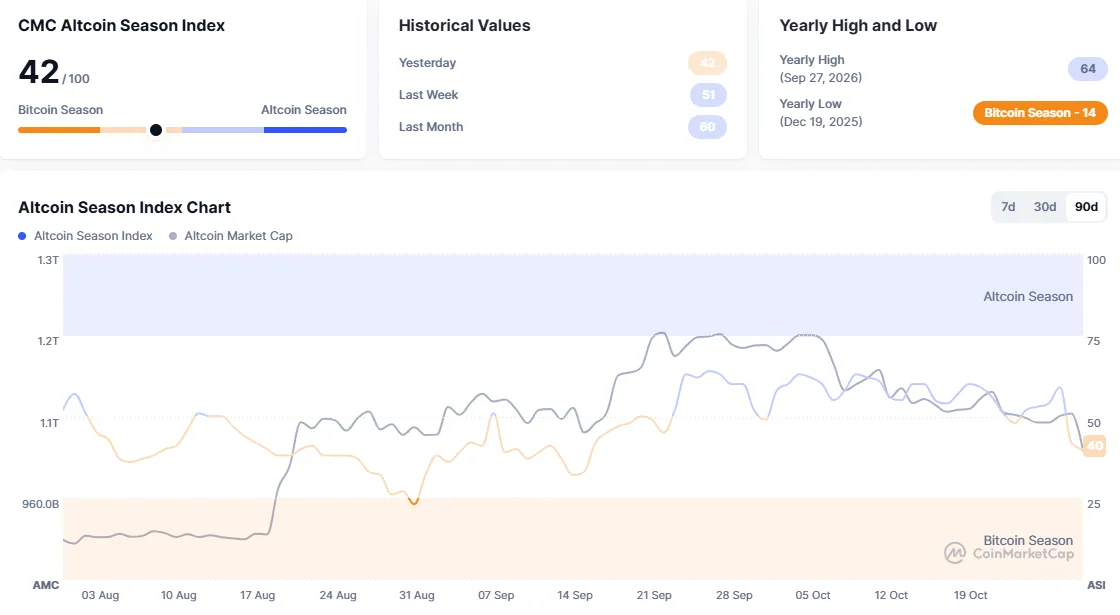
CoinMarketCap’s Altcoin Season Index stood at 40, down 17 points from yesterday.
The index, published by the cryptocurrency market data platform, is calculated by comparing the price performance of Bitcoin with that of the top 100 coins by market capitalization, excluding stablecoins and wrapped coins. An altcoin season is identified when 75% of those top 100 coins have outperformed Bitcoin over the past 90 days, while the opposite is considered a Bitcoin season. A reading closer to 100 indicates altcoin season.
00:44
A Binance hot wallet hacker-linked address deposited 60 million USDT into decentralized lending protocol Aave and then borrowed 19,762 ETH, worth about $44.7 million, BlockBeats reported. According to Etherscan, the address is labeled Binance Hot Wallet Exploiter3 and deposited USDT into Aave V3 before borrowing ETH in two transactions starting at 8:57 p.m. UTC on Oct. 29. The address was later found to have transferred a total of 23,314.5 ETH to another address linked to the hacking incident.
00:32
Binance’s Ethereum reserve ratio backing customer assets may have fallen to around 94% following the hack, CoinDesk reported.
According to CoinDesk’s analysis of Binance’s proof-of-reserves, or PoR, data, the wallets drained in the attack were the same wallets Binance had disclosed as evidence that it held customer assets on a one-to-one basis. CoinDesk said this suggests some cryptocurrencies could remain under-reserved until Binance replenishes the stolen assets.
According to Binance’s Oct. 1 PoR data cited by the outlet, the "Binance 14" address hit in the hack held 1.26 billion USDT and 89,475 ETH at the time. CoinDesk said the attacker appeared to have exploited Ethereum’s EIP-7702 feature to configure the wallet so its assets would be automatically transferred to the attacker’s address. It added that 167,464 ETH was moved from Binance 14 and 28,005.6 ETH from Binance 16 to the attacker’s wallet, before 195,460 ETH, worth about $442 million, was transferred to another address around 15 minutes later. The total stolen amount was about 204,500 ETH, equal to 5.6% of Binance’s ETH reserves at the time, the report said.
00:30
Visa has joined the Canton Network as a super validator, according to Canton, a privacy-focused blockchain for institutional finance. Canton Network was also mentioned during Visa’s fourth-quarter earnings conference call as part of the company’s on-chain network strategy, alongside Tempo and Circle’s Arc.
00:30
Binance hackers sold their entire 777 billion PEPE holdings and exchanged them for 14,049 ETH, according to ai_9684xtpa. The sale was worth more than $31.9 million at an average price of $0.0000041, and PEPE fell 12.33% amid the large-scale selling.
00:29
The Binance crypto hack may have stemmed from abuse of transaction-signing infrastructure rather than a private key leak, Cointelegraph reported, citing Blockaid co-founder and CEO Ido Ben-Natan.
Ben-Natan said the attacker may have manipulated the signing system to get a malicious transaction approved without directly stealing private keys. The attacker is believed to have targeted a Binance wallet by bundling 50 EIP-7702 approval requests into a single transaction, with one of them meeting valid approval conditions and making the asset theft possible.
He added the method closely resembled the 2025 Bybit hack and also mirrored tactics associated with North Korean-linked hackers.
00:26
Major exchanges have seen $393 million worth of futures liquidated in the past hour. In the past 24 hours, $1,431 million worth of futures have been liquidated.
00:23
Jonathan Man, Bitwise’s head of DeFi, said the collateral assets used in the firm’s managed vaults and investment strategies were not affected by the Binance hack. Man said the company’s managed vaults have no Binance-related exposure and it had confirmed no issues with the collateral assets.
He added the DeFi market appeared to have seen relatively less direct impact, but liquidity was tightening across major lending markets as demand for safe-haven assets spread.
