Live Feed
New
Today, October 17, 2026
01:11
South Korea’s Ministry of Economy and Finance will hold a closed-door meeting with cryptocurrency exchange executives on tax policy at 1:00 a.m. UTC on Oct. 19, Digital Asset reported.
According to the outlet, First Vice Minister Kwon Dae-young and other government officials are expected to attend, alongside exchange representatives and the Digital Asset eXchange Alliance (DAXA). Separately, at the National Assembly, the opposition has stepped up pressure for a delay as it began proposing a bill to scrap the tax and continued its offensive during the parliamentary audit.
00:29
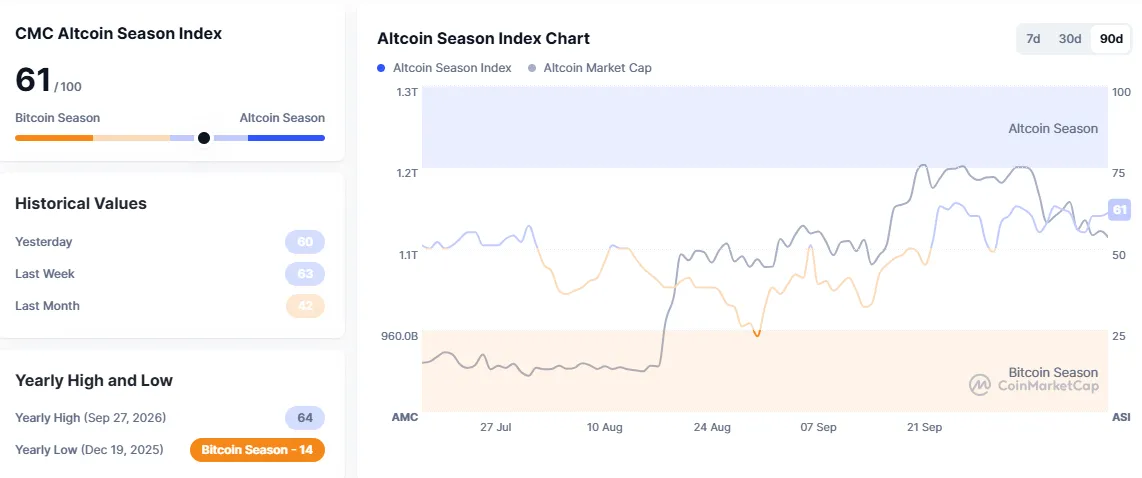
CoinMarketCap’s Altcoin Season Index came in at 61, up four points from yesterday. The index is calculated by comparing Bitcoin’s price performance with that of the top 100 coins by market capitalization, excluding stablecoins and wrapped coins. A reading indicates altcoin season when 75% of the top 100 coins have outperformed Bitcoin over the past 90 days, while the opposite is considered Bitcoin season. The closer the index is to 100, the stronger the signal for altcoin season.
00:02
Spot CVD is an order-book analysis chart for the BTC/USDT spot trading pair. The upper panel shows a volume heatmap, while the lower panel represents cumulative volume delta, or CVD.
- The upper volume heatmap tracks trading volume at each price level, and the background becomes brighter when the price stays in a specific range for an extended period or makes a large move. Brighter zones may act as support or resistance.
- The lower CVD indicator shows buy and sell orders by capital size, with each color-coded line rising as buy orders increase for that segment. The yellow line reflects orders between $100 and $1,000, while the brown line tracks large orders between $1 million and $10 million, among other categories.

00:00
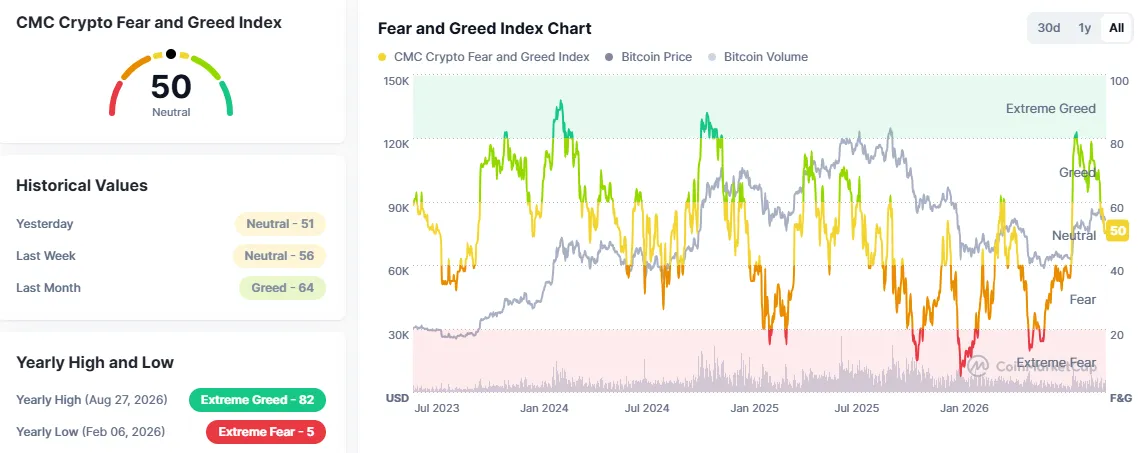
CoinMarketCap’s in-house crypto fear and greed index came in at 50, down one point from yesterday, and remained in neutral territory. A reading closer to zero signals extreme fear in the market, while one closer to 100 indicates extreme optimism. The index is calculated using price moves among the top 10 cryptocurrencies by market capitalization, market volatility, derivatives-market indicators such as the put/call ratio, the stablecoin supply ratio, and CoinMarketCap’s own search data.
Yesterday, October 16, 2026
23:40
Decentralized perpetual futures exchange Deepsigma has launched a real-time paper trading platform covering 77 traditional financial markets, including U.S. stocks, stock indices, commodities and Treasury yields, Bitcoin News reported. Built on the Cypherium blockchain, the platform lets users simulate long and short positions based on price moves across various assets. Supported markets include the S&P 500, Dow Jones, Nasdaq Composite, Russell 2000 and the VIX, as well as crude oil, gold, silver, natural gas and copper.
23:21
Sui-based Bitcoin-collateralized lending primitive Hashi said its cumulative total value committed has surpassed $500 million. Hashi supports the use of Bitcoin in DeFi while keeping the asset on its native blockchain and aims to lower entry barriers that have limited institutional investors’ participation in DeFi.
23:05
Crypto industry super PAC Fairshake and affiliated groups have spent more than $52.6 million on Ohio’s Senate race, according to filings with the U.S. Federal Election Commission.
As of Oct. 15, Defend American Jobs, a Fairshake-affiliated group, had spent about $46.66 million, the filings show. That total included $15,600 for producing campaign materials opposing Brown that were disclosed on Oct. 13.
20:51
Liquidity restaking protocol Ether.fi (ETHFI) said layer-two network Blast is shutting down and advised weETH holders to withdraw assets by Oct. 26.
According to Ether.fi, Blast decided to end operations as the chain’s operating costs exceeded revenue generated on the L2 and no economically sustainable path was visible. As part of the shutdown process, withdrawals of Blast’s Lido assets will be handled first and are expected to take about one week. During that period, withdrawals will be temporarily suspended. Once that process is complete, withdrawals will resume with the delay reduced to 24 hours. Asset withdrawals will still be possible after Oct. 26, but users will need to access Blast’s bridge contract on Ethereum L1 directly.
20:06
The three major U.S. stock indices closed lower today.
- S&P 500: -1.09%
- Nasdaq: -2.14%
- Dow Jones: -0.34%
19:46
Broadcom, Verizon and UnitedHealth have opposed plans to tokenize their shares after the U.S. SEC announced rules on tokenized stock trading last month, The Wall Street Journal reported. AMC Entertainment CEO Adam Aron had earlier also reiterated his opposition to Robinhood’s tokenization of AMC shares and said he would not back down, according to the report.
18:48
TD Cowen raised its price target on Bitcoin accumulation company Strive (ASST) to $56 from $44, while maintaining its Buy rating.
18:33
Guy Wuollet, a partner at a16z crypto, said blockchain’s key near-term growth opportunity remains in finance.
In an interview, Wuollet said stablecoins and perpetual futures are the main areas. Demand for stablecoins is supported by efforts to improve payment efficiency and by demand to hold U.S. dollars in countries with high inflation and capital controls, Wuollet said. Wuollet added stablecoins and blockchain are likely to drive the digital transformation of the financial industry, in a shift similar to how cloud services changed corporate IT environments. He also said a16z is watching payments, lending, credit, exchanges, prediction markets, derivatives, crypto AI, and asset management.
18:26
Stablecoin-based cross-border remittances are about 84% cheaper than traditional methods, according to a report from global liquidity network Borderless.xyz.
The report found that sending $200 with stablecoins carries a median cost of 1%, or $2, versus a median cost of 6.36%, or $12.72, for conventional cross-border remittances based on World Bank data. It added that stablecoin transfers could reach a recipient’s local bank account within minutes, while traditional SWIFT international transfers were generally settled the next day. Some took as long as three business days.
17:54
Whale Alert reported that 213,600,000 USDT has been transferred from an unknown wallet to Bitfinex. The transaction is valued at about $213 million.
17:22
The Nasdaq’s intraday loss widened to 2.04%. The S&P 500 was down 1.17%, while the Dow Jones was off 0.57%.
17:17
According to CoinNess market monitoring, BTC has fallen below $81,000. BTC is trading at $80,995.04 on the Binance USDT market.
17:07
Michael Saylor criticized index provider MSCI over its plan to exclude Strategy (MSTR) and other companies from its global indexes in December, calling the move anti-Bitcoin bias, according to Bloomberg.
In an interview with Bloomberg, Saylor said MSCI recognizes oil, natural gas, land and machinery as capital but does not treat Bitcoin as capital. Saylor added that such an approach amounts to acting like an unregistered financial adviser. Using the English phrase from the interview, Saylor said, "Digital Credit is our product." Saylor added Strategy is actively operating a business that produces what Saylor described as the world’s best credit and said the company is a going concern, which is not open to debate.
MSCI said yesterday it had decided to introduce new criteria restricting index inclusion for non-operating companies. Under the new rules, Strategy and Metaplanet are expected to be removed from the MSCI Global Investable Market Index (GIMI) starting in December. MSTR was trading at $137.07, down 9.46%.
Previous related news
16:33
U.S. investment adviser Unique Wealth disclosed roughly $10.4 million in Bitcoin investments through an SEC 13F-HR filing, according to Crypto Briefing. The firm bought Bitcoin via spot ETFs including Bitwise’s BITB and BlackRock’s IBIT. Its largest position was BITB at about $5.3 million, while IBIT accounted for about $2.1 million. As of the second quarter, Unique Wealth’s total portfolio was valued at about $858 million.
16:08
Bitcoin mining difficulty rose 5.92% from the previous level to 140.58T.
15:28
Decentralized perpetual futures exchange Lighter has launched an EVM development network built in partnership with Axiom, according to the company. The OpenVM-based EVM-equivalent rollup runs in parallel with Lighter Core and allows developers to deploy smart contracts using tools such as Foundry and Hardhat.
Through the network, developers can query account, balance, position, order, and market data on Lighter Core, while also creating, modifying, and canceling orders directly through smart contracts. Lighter plans to gradually expand access to the network and open it to all developers within the next few weeks.
15:18
U.S. CFTC Chairman Michael Selig said in an interview with Fox Business that fraud and market manipulation know no borders, reiterating that this is why the agency has exclusive jurisdiction over prediction markets.
Selig said prediction market platforms are interstate businesses that accept and match buy and sell orders from customers across the United States. He added that Congress gave the CFTC the authority and tools needed to enforce consistent standards across state lines, monitor and crack down on fraud and market manipulation, and protect customer funds.
15:07
Wall Street investment bank Cantor Fitzgerald has raised its price target on Strategy to $208 from $186 while maintaining an Overweight rating, citing an upward revision to its Bitcoin forecast.
14:22
The Starknet Foundation on Oct. 16 announced a dedicated Starknet VIP Program for holders of its native token STRK and wrapped Bitcoin asset strkBTC. Eligible holders can apply through vip.starknet.io.
VIP-tier investors will receive direct communication with the foundation’s core team, dedicated senior-level support, priority access to tickets for major global conferences, and additional ecosystem benefits to be disclosed later.
14:20
Cobo Wallet announced it will officially shut down its app service on Dec. 1, 2026.
Users must withdraw or transfer all assets by 2:59 p.m. UTC on Nov. 30, 2026, and also change any Cobo Wallet deposit addresses previously set on other platforms. If assets are not withdrawn by the deadline, Cobo said it will charge a 2% monthly custody fee on remaining account assets, with a minimum monthly fee of around $100.
14:15
Mark Karpeles, former CEO of the bankrupt cryptocurrency exchange Mt. Gox, criticized Ledger for failing to respond adequately despite receiving tips for months about counterfeit hardware wallet incidents, Cointelegraph reported.
Karpeles said at least two people had reported issues involving fake devices to Ledger since December last year. Ledger replied it would launch an internal investigation, but proper follow-up action did not take place, he added.
